
Here’s the idea…
I’ve been so excited to see personal curriculums trending on social media lately! As a former teacher, who is also a former Gifted kid, just now starting to understand my own neurodiversity, I LOVE learning, but I NEED structure.
I am 100% that person with a huge stack of notebooks, and just as many files in Google Docs, all abandoned a few pages in with a messy amalgamation of notes, links, book titles, and images. Don’t ask me why it never occurred to me (until I quit teaching) to formally organize my interests and set myself up with some structure.
Last year, I started building a curriculum to support my journey as a writer of witchy books. I chose mentor texts, set up a reading schedule, and assigned myself mini projects to test my learning.
It was successful for about three months, which is about a quarter of the school year and the amount of time I was used to devoting to this kind of work. I dropped off around the holidays and had trouble getting back into my schedule.
This year, inspired by all the motivated creators I’m seeing, I’d like to suggest we join forces. I want to create a space where learners can share their curriculum in whatever way feels comfortable. Maybe you link your syllabus and give people an overview of what you plan to study. Maybe you share your reading list, or set up buddy reads and study groups. Maybe you host your own lives where you share what you’ve learned.
Obviously, building a full course is hugely time consuming and any of these steps could be monetized in various ways. And I completely encourage that if you want to make a job out of it. But if you’re keeping your curriculum as a hobby, or you’re using this one to learn how to do it so maybe you can sell courses later, this might be a good way to share knowledge and resources, and potentially get feedback (if you want it).
Join the Learning Community on Discord!
How to organize your curriculum and develop a syllabus:
Everything you’re about to read comes with the standard disclaimer: This is how I design curriculum, I know people who do it successfully more or less the same way. I also know people who use significantly different methods. YMMV,
That said, the following should give you a rough idea about how I organize a course.
Choosing a course topic
FIRST, you need to figure out what your courses are going to be. I know, sounds obvious, right? If you already know what your focus topic is, skip ahead. If you need some guidance narrowing things down, come in and sit down. We’re about to go through it.
Get a piece of paper, or open a doc, or get out your notes app. Make a list of all the things that interest you. They might be listed as subject headings, themes, or questions you want to answer. If it’s a list with only one entry, you’re done. If there are several entries, refer to the Venn Diagram.
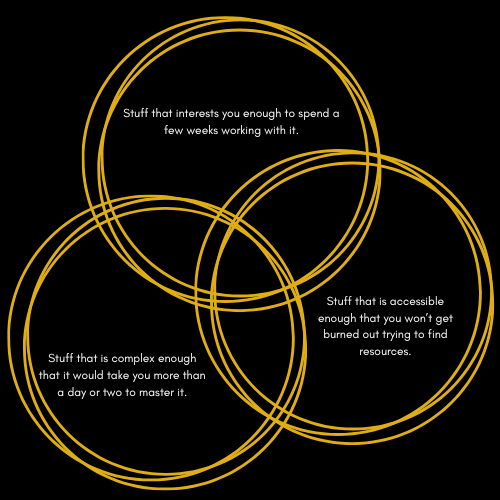
Sort the topics on your list into the diagram. During this process, you may find yourself combining things, breaking them into smaller components, or dropping them altogether. That’s fine. This is YOUR curriculum. There’s no wrong way to do it (unless it doesn’t work, but then you use that to learn what does work).
The first category is Stuff the interests you enough to spend a few weeks working on it. If a subject isn’t going to hold your attention over time, it’s not worth creating a course. Go Google it, or read a blog about it, or call someone you know and have a chat. You’re not going to study it.
The second category is Stuff that is complex enough that it would take you more than a day are two to master it. Again, if your question can be answered with a quick Google search, you don’t need to build a course for it. This is also where you consider the possibility that you’ve asked a question that can’t be answered, or one that will take more time for you to get an acceptable answer than you are willing to spend on it. This is also fine. You just have to live with the unknowable or accept the lack of closure. Or make it your life’s work. IDK. You do you.
The third category is Stuff that is accessible enough that you won’t get burned out trying to find resources. Unless this course is going to be your life’s work, or you intend to develop groundbreaking, world-changing research, pick something that somebody has already covered. This may mean broadening your topic choice at first and tightening it up as you get into it. One resource will often lead to another (check the bibliographies, appendices, and acknowledgments), but you have to know where to start.
Got that diagram sorted? Great! What’s in the middle? Just one thing? That’s the topic for your first course. Did you fit a few different options in there? Nice! You might be ready for multiple courses! But let’s pick one to start with, okay?
Creating a syllabus
A syllabus is the document that teachers give students to help them understand what the expectations are for a class. In high school, they often make you tape it into your notebook or put it as the first page in your binder. This is the thing that has all the rules, resources, assignments, deadlines, and assessments in one place. You’re going to want to reference it throughout the course.
Here the main components:
- Course Title
- Course Goals or Objectives
- Core Texts and Resources
- Schedule
- Assessments
Obviously, this is your syllabus, so feel free to adapt it to your needs, but these five sections are pretty standard in curriculum planning. And if you eventually want to share this with other learners, having them in place will help the people outside your head understand what was going on inside.
Your course title should be clear and descriptive. You want people to understand what the topic is and potentially what aspect of a broader topic this course intends to cover. History is pretty broad. The History of North America narrows is down a little. The History of Cryptids in the Appalachian Mountains gives readers a distinct picture of your focus area.
Course Goals are usually written as sentence or short paragraph explaining the purpose of this study, often phrased as “The student will be able to…” These goals can be written in terms of knowledge gained or skills attained. For example: The student will be able to identify and describe common supernatural creatures found in the legends of the Appalachian Mountains and explain their influence on the development of local culture. Or The student will be able to consistently bake chocolate chip cookies that would make her grandmother proud.
The next section is going to require a little bit of research. Depending on the complexity of your topic, you may need several resources, but I recommend starting with three. Ideally, these three would be varying formats, in addition to being multiple viewpoints. So, you might look for one book, one video, and one podcast. Or not. Again. This is your curriculum. Do what works for you. You might prefer everything as a pdf you can read on your phone, or you might only want to watch YouTube videos or listen to Spotify.
Whatever you do, PLEASE seek out a variety of sources, check them for reliability, and read/view/listen with a critical mind.
When I build a course, I usually break it into five units, and further divide each of those units into four week-long lessons. Your schedule needs to fit around your life and move at a pace that feel comfortable. This personal curriculum is meant to enlighten and fulfill you, not stress you out or bore you.
Each unit focuses on a subset of the greater topic of the course. So, our cryptid class might have units on specific creatures, general history of the area, geography, modern culture of Appalachia, and connections to other cultures.
Within each unit, I develop a focus question, weekly reading assignments, suggestions for additional research, and some kind of activity or practice to review or strengthen what was learned.
Assessments are usually a way to determine if the student has reached the desired outcome of the course. Basically, how will you know you have successfully achieved your goals? Because when you finish the course, you need to decide if you are truly finished with this topic. If it was a success, congratulate yourself, throw a little party, show off to all your friends (and then maybe start a new course). If it wasn’t, review your work and try to figure out what went wrong. Is it a process problem or a performance problem? From there you can either revise and review, or create a new unit or course that approaches your goal differently. Take what you learned in Cryptids 101 and apply it to Crypids 201.
Find me on TikTok or in our Discord and let me know if this was helpful, if you have any questions, or if there is any other aspect of curriculum planning you’d like me to cover! Thanks for joining me!
Ready to share?
Explore the Curriculum Sharing Database and add your own.
<Updated 10/22/25>
 Jenn Lessmann